The highly anticipated 2026 and 2027 Renewable Volume Obligations (RVOs) were released by the EPA on June 13 2025, offering valuable insight into the new administration’s stance on the future growth of the renewable fuels market.
RNG market participants had been awaiting this release to better understand the demand outlook for D3 RINs in the coming years. While the EPA’s proposed targets are lower than many in the market had anticipated, the agency stated that these figures reflect the expected growth in compressed natural gas (CNG) vehicle fuel demand for those years. Industry stakeholders continue to advocate for higher targets, citing the projected robust growth in RNG production capacity. Nevertheless, the release of the proposed RVOs is a positive development, providing greater certainty regarding the RIN supply-demand balance and a framework for valuing RNG in transportation applications.
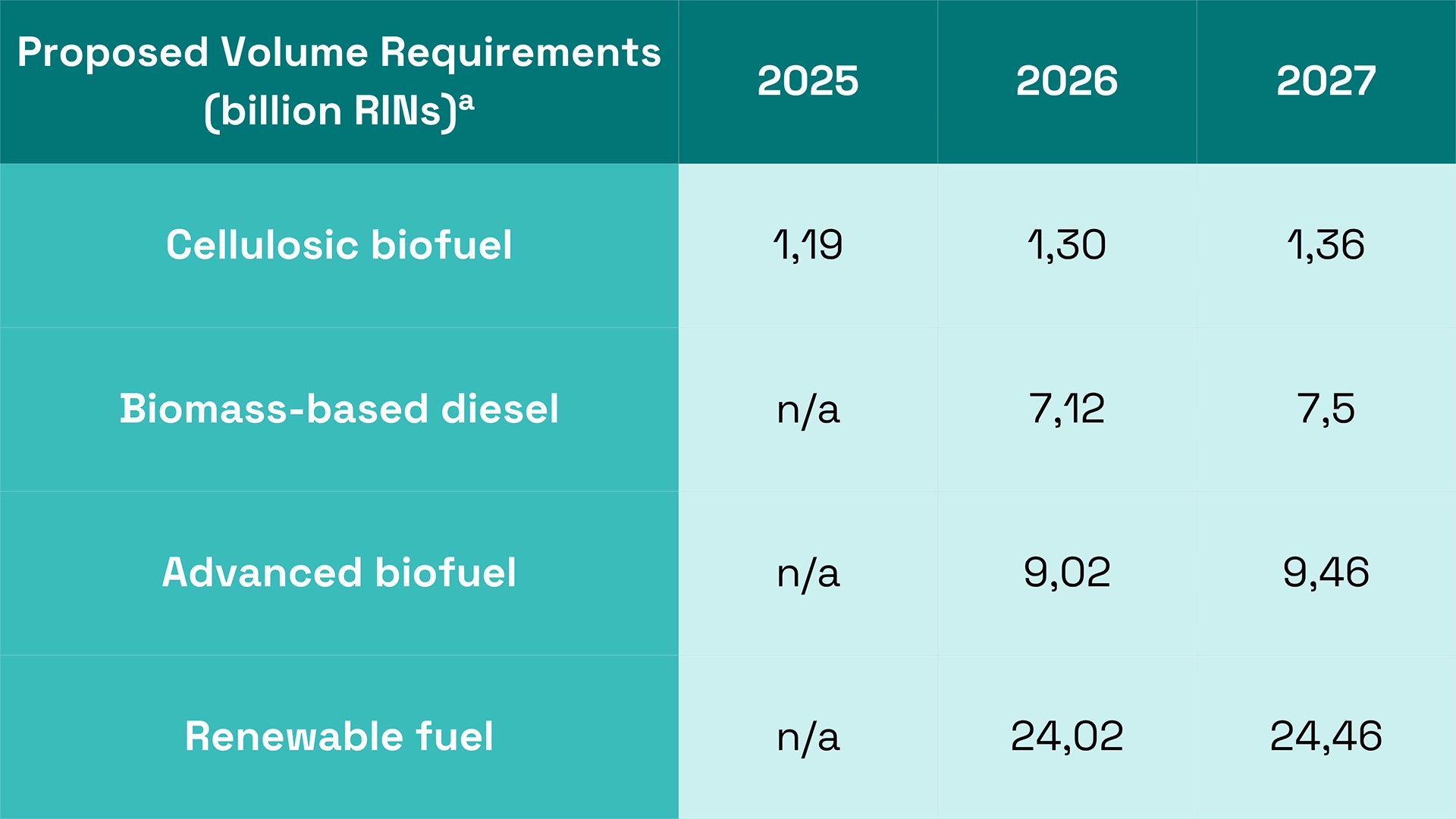
Proposed renewable fuel volume requirements, expressed in billion RINs, for the 2025–2027 period.
In another encouraging sign for the industry, the recently signed budget reconciliation package includes incentives for the biofuels sector. The 45Z Production Tax Credit—which offers tax relief for the production of low-emission transportation fuels—remains active under this bill and has been extended by two years, through 2029. This extension is a significant win for the RNG industry, offering financial stability to support the ongoing development of RNG projects and the broader expansion of domestic biofuel production.
Following months of uncertainty surrounding the Trump administration’s approach to RNG and the broader biofuels sector, these two key developments provide much-needed clarity, confidence, and momentum for industry stakeholders. Together, the EPA’s proposed RVOs and the extension of the 45Z tax credit signal a supportive policy environment that encourages investment and long-term planning. These measures are expected to drive continued expansion in RNG infrastructure, strengthen the market for low-carbon fuels, and help position the United States as a global leader in renewable energy and sustainable transportation solutions.
Key Terms Explained
- D3 RINs are compliance credits generated from cellulosic biofuels like RNG. They’re used by fuel producers to meet federal Renewable Fuel Standard (RFS) blending requirements.
- CNG, or Compressed Natural Gas, is a cleaner-burning alternative to gasoline or diesel used in vehicles. RNG can be upgraded and injected into natural gas pipelines to supply CNG fleets.
- RVOs, or Renewable Volume Obligations, are annual targets set by the EPA that determine how much renewable fuel must be blended into the U.S. fuel supply.
- The budget reconciliation package refers to a major federal bill that includes clean energy and climate-related tax credits and funding. The 45Z Production Tax Credit, introduced in the Inflation Reduction Act, provides financial incentives for producing transportation fuels with low lifecycle greenhouse gas emissions—including RNG.
At a glance

Clear Policy Signals for RNG Growth
The EPA’s release of the 2026–2027 Renewable Volume Obligations provides long‑awaited visibility on future demand for renewable fuels, helping structure expectations for RNG and D3 RIN markets.

Supportive Market Framework for Transportation RNG
The proposed RVO volumes reflect anticipated growth in CNG vehicle fuel use, reinforcing RNG’s role as a scalable, low‑carbon transportation fuel and strengthening confidence in long‑term market fundamentals.

Extended Incentives Strengthen Investment Confidence
The two‑year extension of the 45Z Production Tax Credit through 2029 delivers financial stability for RNG projects, encouraging continued infrastructure development and positioning the U.S. as a leader in renewable fuels.
Contact our experts