
The RFS: America's Renewable Fuel Engine
The Renewable Fuel Standard (RFS) is the federal program that underpins the economics of Renewable Natural Gas in the United States. Administered by the Environmental Protection Agency (EPA), the RFS requires fuel refiners and importers to blend a minimum volume of renewable fuels into the nation's transportation fuel supply each year.
To demonstrate compliance, obligated parties must acquire tradable credits called Renewable Identification Numbers (RINs) — each corresponding to one gallon-equivalent of renewable fuel. For RNG producers, RINs represent the primary source of "green value" that makes landfill gas-to-RNG projects economically viable in a country where the price of natural gas is very low..
Where Does RNG Fit?
The RFS classifies renewable fuels into four categories based on their feedstock and lifecycle greenhouse gas reduction. RNG produced from landfill gas, wastewater treatment plants, or anaerobic digesters qualifies as a cellulosic biofuel (D3-RIN) — the highest-value category, requiring a minimum 60% GHG reduction compared to fossil fuels.
This classification was a game-changer for the landfill gas industry. Since the EPA's 2014 pathway approval, landfill-derived RNG has been eligible for D3 RINs, significantly boosting the economic case for upgrading landfill gas into pipeline-quality biomethane rather than simply flaring it or converting it to low-value electricity.
A Growing and Resilient Market
The EPA sets annual volume requirements — known as Renewable Volume Obligations (RVOs) — that determine how many RINs must be retired each year. For D3 cellulosic biofuel, the trajectory is clearly upward.
A key strength of the RFS is its bipartisan durability. Established under the Bush administration in 2005, the program has been maintained across successive Democratic and Republican governments. The current administration has positioned biofuels — including RNG — among the energies to be promoted. In March 2026, EPA Administrator Lee Zeldin called the latest RVO rule "historic," setting "the highest levels of biofuels ever required" in the program's 20-year history.
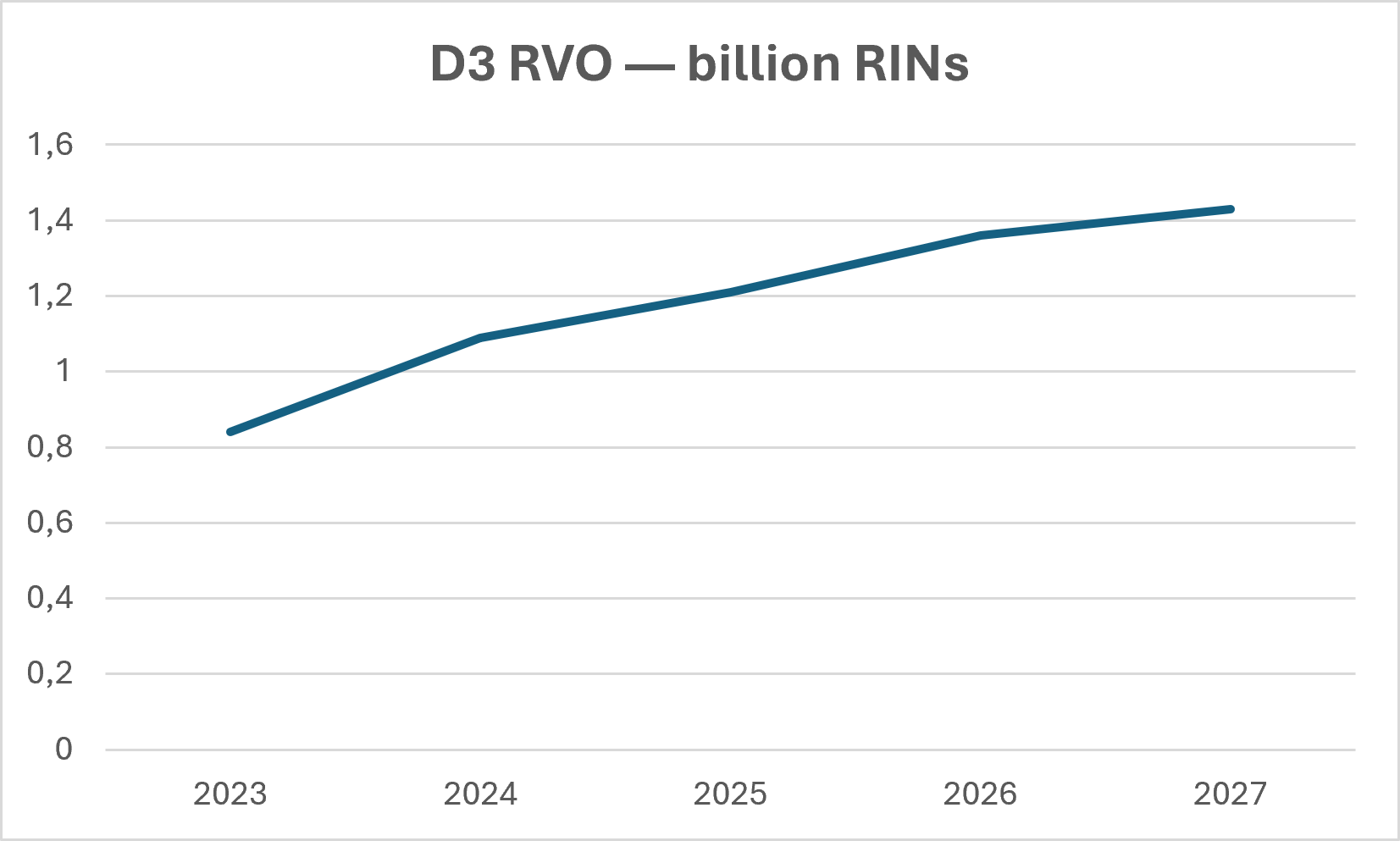
Source: EPA Set 1 (June 2023) and Set 2 (March 2026) Final Rules
Beyond the RFS: Additional Revenue Streams
The RFS is not the only mechanism supporting U.S. RNG economics. Several complementary programs create stackable revenue streams for producers:
- State-level programs: Low Carbon Fuel Standard (LCFS), for example in California, awards additional credits based on the carbon intensity reduction achieved. Oregon and Washington have implemented similar mechanisms.
- Federal tax credits: The Production Tax Credit (PTC, section 45Z), extended through December 2029 under the "One Big Beautiful Bill Act" (OBBBA) signed in July 2025, provides additional support tied to the carbon intensity of the biofuel produced.
- Voluntary market: A growing number of corporations and institutions are committing to purchase RNG through long-term contracts, independently of any regulatory mandate — driven by their own decarbonization objectives.
What This Means for RNG Stakeholders
For landfill owners, the U.S. regulatory framework transforms landfill gas from a waste management liability into a revenue-generating asset. D3 RIN eligibility, combined with state-level credits and federal tax incentives, creates a compelling economic case for landfill gas-to-RNG conversion.
For RNG buyers, the long-term stability of the RFS — reinforced by rising volume requirements and bipartisan political support — provides confidence for entering into long-term procurement contracts, while the voluntary market offers flexibility beyond regulated channels.
Looking Ahead: From Domestic Compliance to Global Demand
While the RFS remains the primary demand driver for U.S. RNG, the market is evolving beyond domestic compliance. On the supply side, U.S. RNG production capacity has grown by 35% between 2023 and 2025, driven by favorable economics and federal incentives.
On the demand side, new channels are emerging, in particular on the voluntary markets. For example data centers increasingly produce electricity on site from gas. RNG will then become a key solution for them to reach their ambitious climate goals. RNG in the form of bio-LNG is gaining recognition as a drop-in decarbonization fuel for international shipping, as the International Maritime Organization advances its Net-Zero Framework. Meanwhile, growth in domestic transportation demand will depend in part on the continued expansion of the conversion of trucks to compressed natural gas (CNG).
At a glance

Strengthening Fundamentals for RNG Growth
Clearer policy frameworks and stable market signals—such as D3 RIN prices around $2.50—are reinforcing confidence and improving long‑term visibility for RNG development.

A Supportive Environment for Investment
Key incentives like the 45Z tax credit and sustained demand from utilities and transportation markets continue to support the expansion of low‑carbon fuel production.

Rapid Industry Expansion and Global Demand
The U.S. RNG sector is growing quickly, with a strong pipeline of new biogas‑to‑RNG projects, complemented by rising demand from international markets such as Canada and Europe, supporting long‑term market stability.
Contact our experts

Lucie Tonnellier
Energy Director