Upgrading Hybrid Biogas into Renewable Natural Gas
In Clermont-Ferrand, France, Waga Energy and VALTOM have commissioned Europe’s first WAGABOX® unit capable of upgrading a hybrid biogas stream from two complementary waste treatment facilities into grid-compliant renewable natural gas. The project combines a regulatory breakthrough with Waga Energy’s expertise in treating complex biogas.
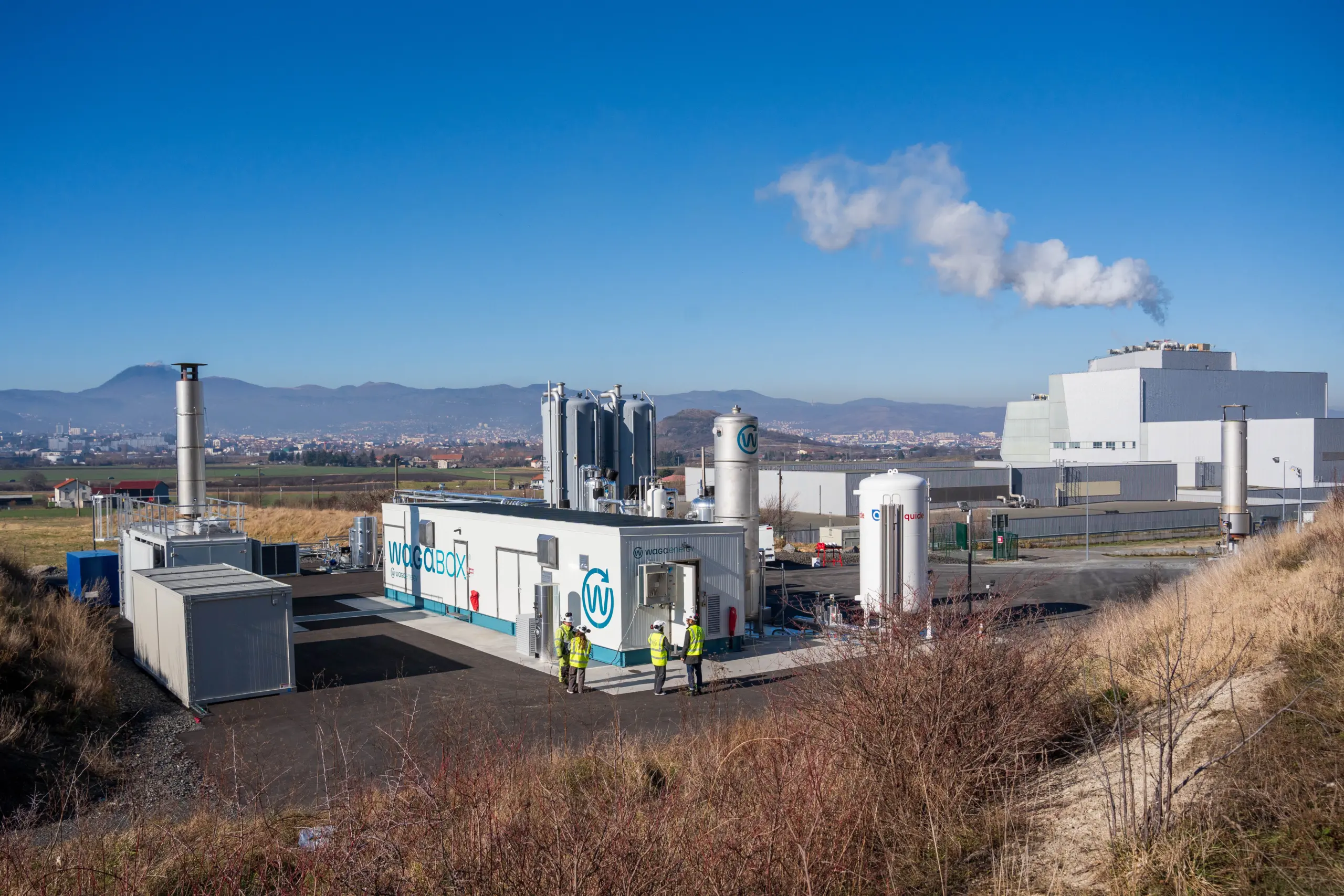
The Clermont-Ferrand WAGABOX® unit is the first facility in Europe to upgrade a hybrid biogas source combining gas from a non-hazardous waste storage site and an anaerobic digestion unit.
Two Biogas Sources, One Regulatory and Technological Challenge
VALTOM is the public authority responsible for the treatment and recovery of household waste in the Puy-de-Dôme and northern Haute-Loire regions, in central France. Serving more than 700,000 inhabitants and managing around 360,000 metric tons of waste annually, VALTOM has long pursued innovative solutions to recover more value from local waste streams.
In Clermont-Ferrand, two significant biogas sources are located just a few hundred meters apart: the Puy-Long non-hazardous waste storage site, which produces biogas from the decomposition of waste, and the Vernéa household waste recovery center, which operates an anaerobic digestion unit processing separately collected food waste.
For years, these two biogas streams were recovered separately and only partially optimized: landfill gas from Puy-Long was converted into electricity through a cogeneration engine, while biogas from Vernéa was used within the site’s waste-to-energy process. VALTOM identified a more efficient opportunity: combining both resources and upgrading them into pipeline-quality renewable natural gas.
This ambition raised two challenges at once. From a regulatory and economic standpoint, the project did not fit into any existing feed-in tariff framework: one tariff applied to biomethane produced from anaerobic digestion, another to biomethane recovered from landfill gas, but no dedicated mechanism existed for a hybrid stream combining both sources. This made the project uncertain until a suitable framework could be established.
The project also required a technological response to a new gas configuration, combining biogas streams with different origins, compositions and operating characteristics. Integrating the two sources into a single WAGABOX® unit therefore required four years of work, carried out in close partnership between VALTOM and Waga Energy and in coordination with French government authorities, to adapt a regulatory framework that had previously been unsuitable for mixed injection.
This determination ultimately led to contract signature in 2022, followed by successful commissioning in December 2024, making Clermont-Ferrand the first project of its kind in Europe.
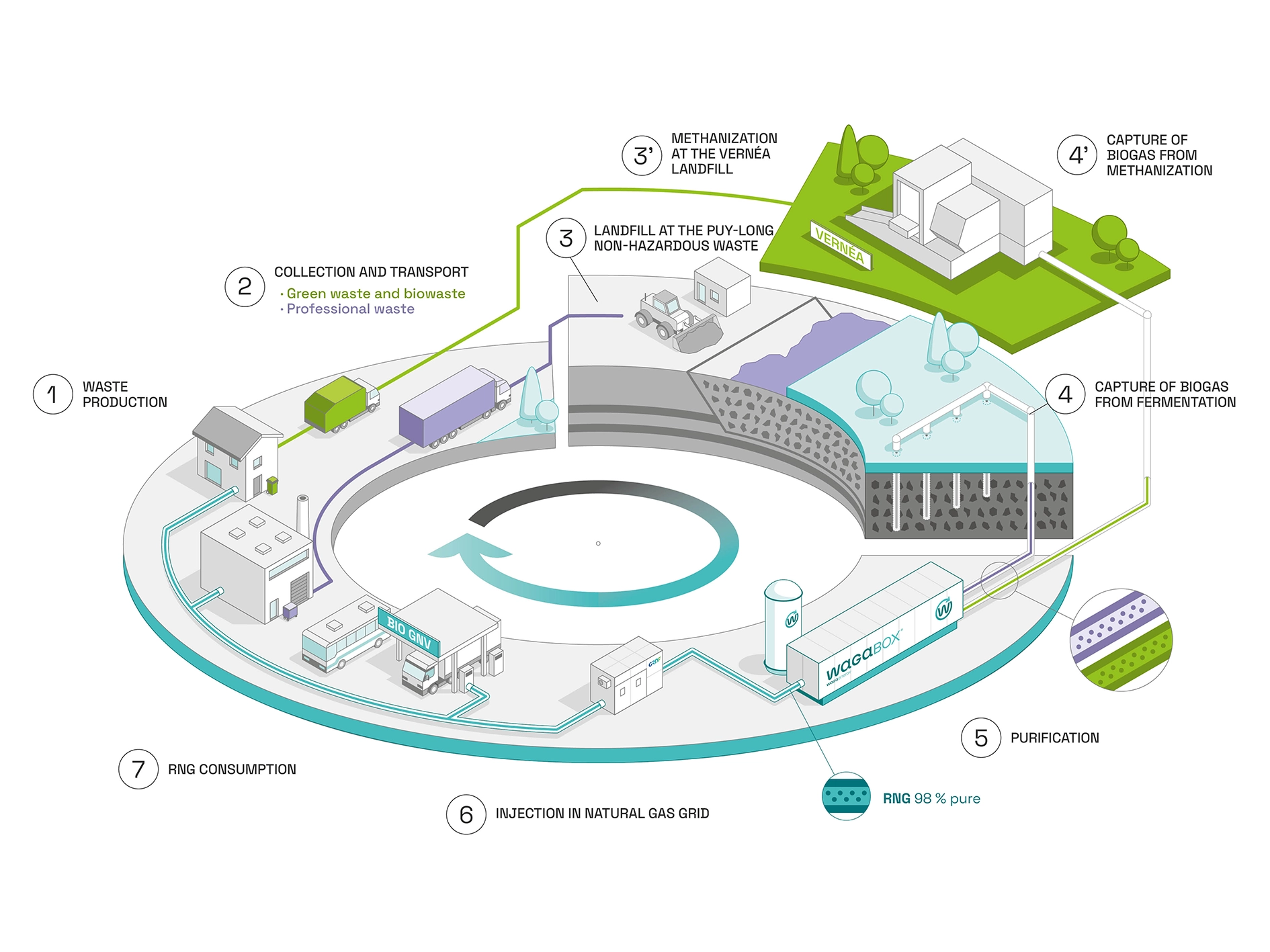
The circular economy in the VALTOM example.
A WAGABOX® Unit Engineered for Complex and Variable Biogas Streams
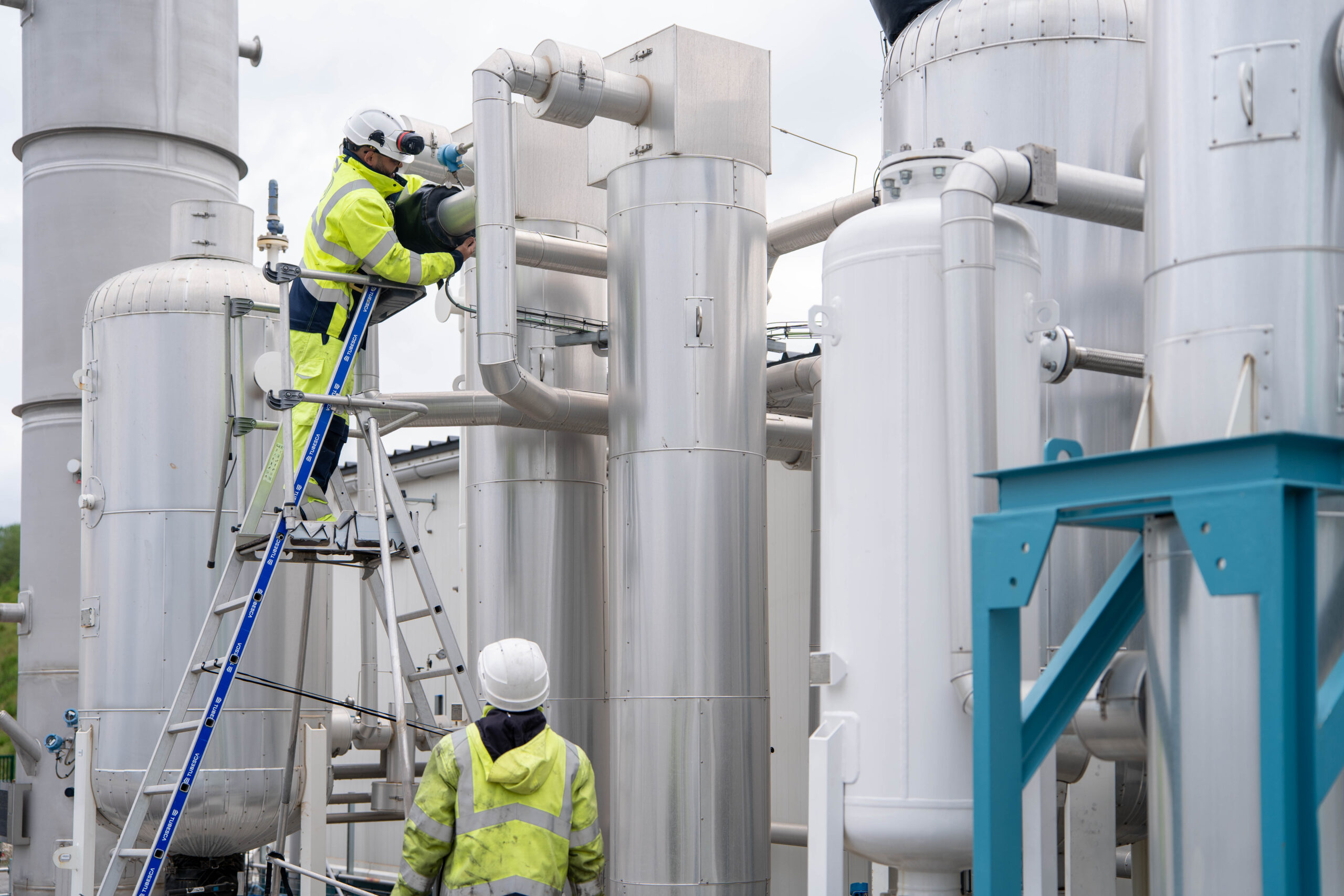
To make the project possible, Waga Energy deployed its patented WAGABOX® technology, a biogas upgrading system combining membrane filtration and cryogenic distillation. This two-step process is designed to separate methane from carbon dioxide, oxygen and nitrogen, producing grid-compliant renewable natural gas even from complex gas mixtures.
This technical capability was central to the Clermont-Ferrand project. Landfill gas naturally differs from biogas produced through anaerobic digestion: it can be more variable in flow and composition and can contain significant amounts of air, introduced during gas collection from waste storage cells. As a result, it typically contains oxygen and nitrogen levels that are more challenging to manage than in conventional digestion biogas.
The WAGABOX® technology was originally developed to upgrade this type of demanding landfill gas. Its process architecture is therefore natively suited to hybrid biogas configurations: membrane filtration concentrates methane and removes most carbon dioxide, while cryogenic distillation further purifies the gas by removing residual air components, including oxygen and nitrogen, to meet gas grid specifications.
At Clermont-Ferrand, two dedicated pipelines convey the biogas from Puy-Long and Vernéa to the WAGABOX® unit. The system manages the combined stream while maintaining stable biomethane quality for injection into the GrDF natural gas distribution network, supplying homes and businesses across the Clermont-Ferrand area as well as the Gandaillat alternative fuel station for CNG vehicles.
The project is operated through VALTOM Énergie Biométhane, a joint venture between VALTOM and Waga Energy, which receives the revenues generated from RNG sales. The total investment of €3.5 million was co-financed by both partners, supplemented by an ADEME subsidy, a grant from the Caisse des Dépôts under the ÉcoCité urban development program, and funding raised through a local crowdfunding campaign on the Enerfip platform.
From contract signature to first gas injection on December 18, 2024, the project was delivered on schedule, demonstrating Waga Energy’s ability to execute complex, innovative projects while adapting its technology to new biogas configurations.
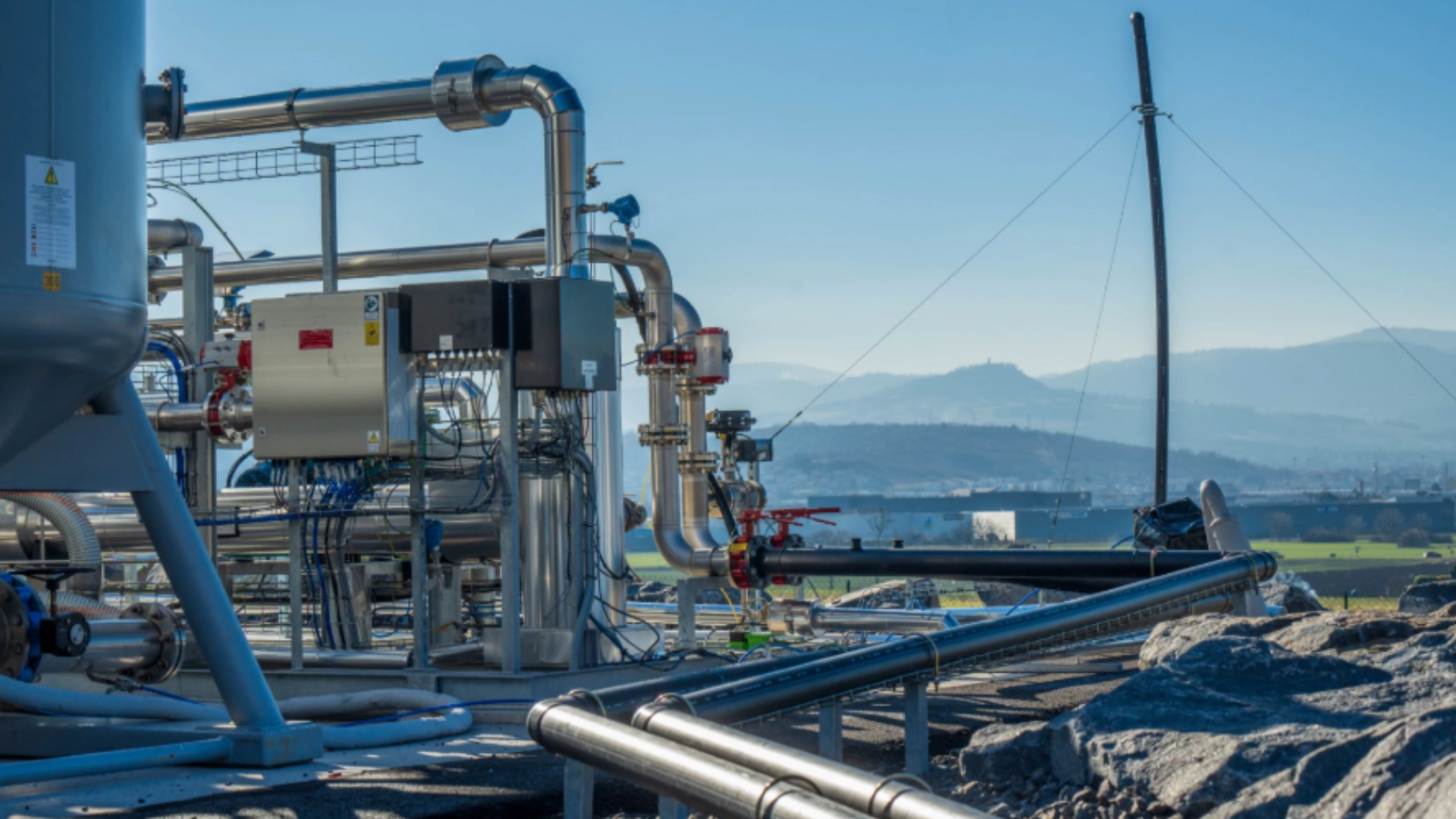
Two pipelines convey biogas from a non-hazardous waste landfill (ISDND) and a methanization unit, which are then combined for energy recovery.
A European First Showcasing the Potential of Hybrid Biogas Upgrading
The Clermont-Ferrand WAGABOX® unit is the first facility in Europe to upgrade a hybrid biogas source combining gas from a non-hazardous waste storage site and an anaerobic digestion unit. With an annual production capacity of 15 GWh, it supplies renewable natural gas equivalent to the consumption of more than 2,000 households.
By replacing fossil natural gas with locally produced RNG, the facility avoids approximately 2,500 tonnes of CO₂ equivalent emissions each year. It also supports uses that are more difficult to electrify, including heavy-duty transport, while strengthening the territory’s energy autonomy.
The project is also a concrete example of circular economy in action. Food waste collected separately by VALTOM is sent to the Vernéa anaerobic digestion unit, where it produces biogas that is upgraded into RNG. This renewable gas can then fuel the very trucks used to collect food waste across the territory.
Laurent Battut, president of VALTOM: “It is up to local authorities to play an active role in the energy transition. This can only be achieved by and for the territories. With this innovative project, carried out with Waga Energy, we are actively contributing to the implementation of a 100% local and renewable energy mix, based on our waste.”
Key Facts
- Location: Clermont-Ferrand, France
- Partner: VALTOM
- Technology: WAGABOX®
- Hybrid biogas source: biogas from a non-hazardous waste storage site and an anaerobic digestion unit
- European first: first WAGABOX® unit in Europe to upgrade this type of hybrid biogas stream into grid-compliant RNG
- RNG production capacity: 15 GWh per year (equivalent consumption of more than 2,000 households)
- CO₂ emissions avoided: approximately 2,500 tonnes eq. CO₂ per year
- Investment: €3.5 million
- First injection: December 2024
Valtom and Waga Energy launch an RNG Injection Project Using a Hybrid Biogas Source
At a glance

Tailored Solutions for Every Resource Stream
Waga Energy analyzes each site individually to deploy the most efficient solution, capable of handling complex and highly variable biogas compositions.

Robust and Scalable Technology
The WAGABOX® technology converts biogas into pipeline-quality biomethane through a reliable, modular process designed to adapt over time to changes in resource streams and operating conditions.

Pioneering Projects Serving Local Communities
The VALTOM project exemplifies this expertise, with the first unit in Europe to simultaneously upgrade two biogas streams—delivering tangible contributions to the energy transition and the circular economy at the local level.