The Changing Role of Landfill Sites
Biomethane production is reshaping the role of landfill sites in the waste-to-energy sector. In this article, we explore how landfill gas can be transformed into renewable natural gas, creating new opportunities for both energy recovery and methane emissions reduction.
The role of landfill in the European waste treatment hierarchy
The evolution of European regulations, structured by Directive 2008/98/EC, clearly aims to drastically reduce waste generation and to systematically recover any recoverable fraction, whether through material recycling or energy recovery. Landfilling is therefore reserved for residual waste — that is, waste that can no longer be reused, recycled, or otherwise recovered.
However, all treatment streams — sorting, recycling, composting, anaerobic digestion, and incineration — generate non-recoverable residues. Some of these non-hazardous residual waste streams still contain an organic fraction that cannot be recovered by upstream processes.
Why must biogas from landfill sites be captured and recovered?
Energy recovery from landfill biogas is a full-fledged waste recovery pathway in its own right. Once landfilled, organic matter naturally degrades and produces biogas, mainly composed of methane and CO₂. Methane is a greenhouse gas with a global warming potential far higher than that of carbon dioxide. It is therefore essential to capture, manage, and recover this biogas in order to limit atmospheric emissions and reduce the climate impact of landfill sites.
Among the various recovery pathways available today, biomethane production stands out as the most effective and efficient solution, both from an energy and climate perspective. It produces biomethane of equivalent quality to natural gas, which can be directly injected into distribution or transmission networks. It also ensures optimal energy efficiency, higher than that achieved when biogas is used to generate electricity. Biomethane improves the environmental performance of landfill sites by substituting fossil fuels in high-emission sectors such as transport and industry.
Biomethane production is repositioning landfills as key contributors to the energy recovery sector
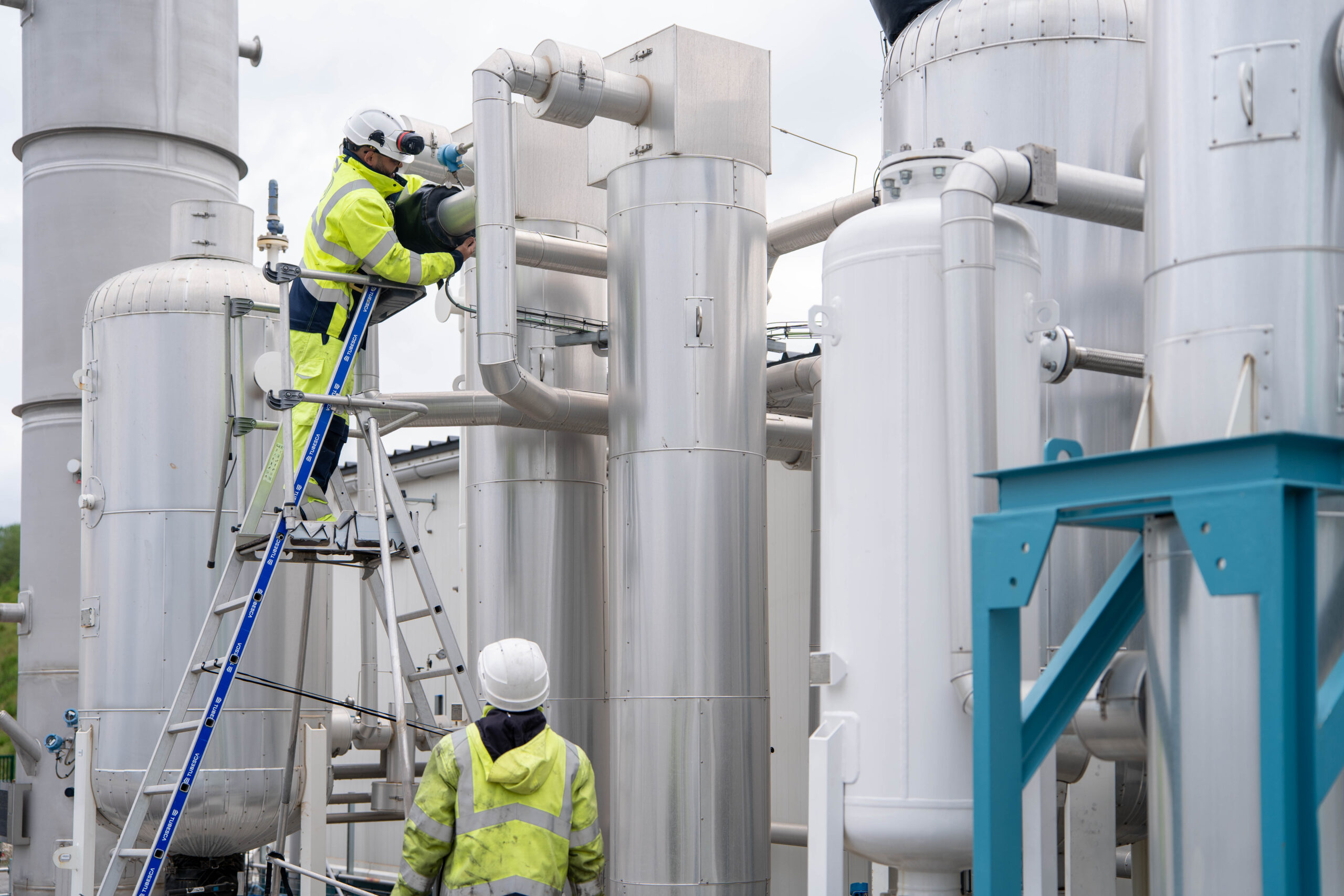
A landfill site equipped with an efficient gas capture system — capable of effectively controlling diffuse emissions — and an advanced purification solution producing biomethane becomes a genuine energy recovery pathway for the residual organic fraction (which cannot be recovered in agriculture).
Landfill cells fitted with effective containment systems operate like unmixed digesters; the degradation of buried waste can be optimized through leachate recirculation practices (bioreactor landfill). The energy production of such a landfill site becomes comparable to that of anaerobic digestion units treating biowaste.
However, biogas production lasts much longer — more than 20 years — because the organic matter is “diluted” within a mass of plastic and inorganic materials. For this reason, long-term biogas capture (during and after cell filling, and even after site closure) is a key challenge in landfill gas management and in maximizing the energy recovery potential of residual waste.
Thus, when the landfill sector integrates sustainable biogas management and biomethane recovery, it fully assumes its role within the energy recovery chain of waste treatment. My colleague David Agudelo-Romero and I contributed to an article on this topic in Annales des Mines (January 2026 issue, No. 121), which shows how upgrading biogas into biomethane repositions non-hazardous waste landfilling at the heart of the energy transition.
Read the full article in Annales des Mines
At a glance

Landfill remains essential for residual waste
Under the European waste hierarchy, landfill is reserved for waste that cannot be reused, recycled, or otherwise recovered. It plays a necessary role in managing the non-recoverable residues generated by all other treatment pathways.

Capturing landfill biogas is a climate imperative
As organic waste decomposes, it produces methane, a potent greenhouse gas. Effective biogas capture and recovery significantly reduce emissions while turning a source of pollution into a source of renewable energy.

Biomethane turns landfill into an energy recovery asset
By upgrading landfill gas into network-quality biomethane, landfill sites become long-term renewable energy producers, helping displace fossil fuels and strengthening their role in the energy transition.